Django Partials
Define, render, complete, and navigate Django 6 partials in templates and Python views.
Template partials are built into Django 6.0. The feature originated from Carlton Gibson's django-template-partials package before landing in Django core.
Define a partial
Use inline when the definition should also render at its definition site:
The partialdef and partialdef-inline snippets insert these structures.
Render a local partial
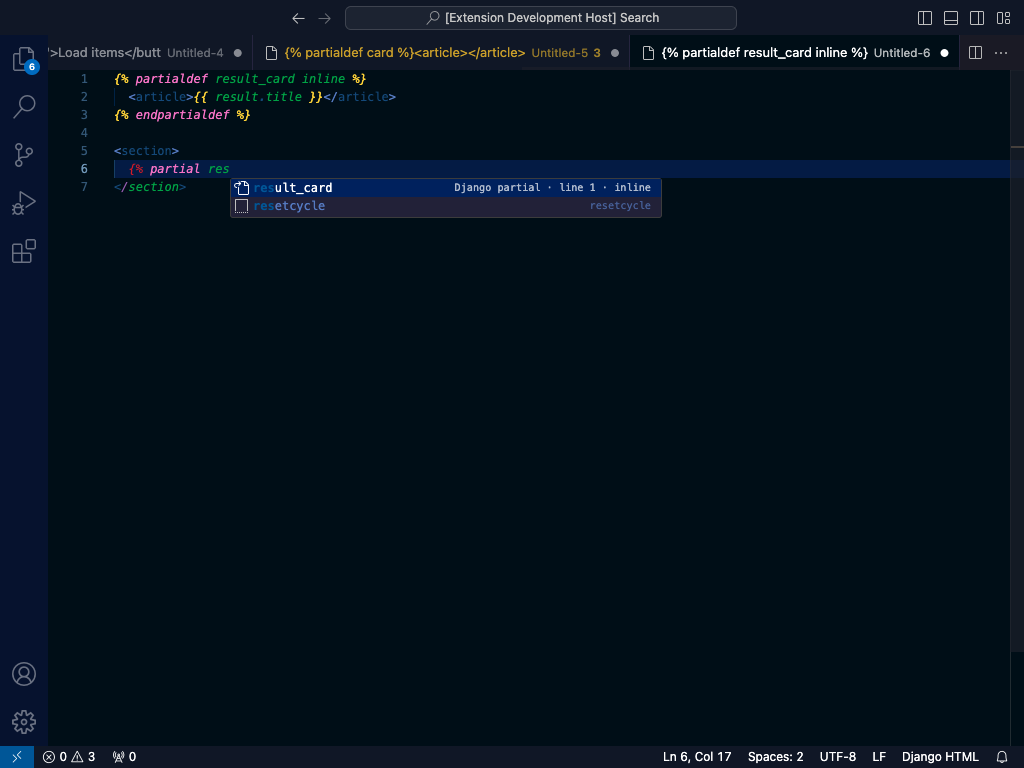
After {% partial, completion offers names defined in the current file. Hovering a definition or reference identifies its definition line and whether it is inline. Go to Definition and Peek Definition jump from the reference to the matching partialdef block.
Typing after {% also offers partialdef, partialdef … inline, partial, and endpartialdef tag completions.
Rename and find references
With the cursor on a partial name, Find All References (Shift+F12) lists the partialdef definition and every {% partial %} use in the file, and Rename Symbol (F2) rewrites the definition and all of its references together. Both work from either a definition or a reference and stay within the current template.
Reference a partial in another template
Completion after # reads definitions from matching workspace templates:
The same completion and navigation work for static template arguments to render, render_to_string, get_template, select_template, and TemplateResponse, including qualified calls and documented keyword arguments:
Diagnostics
The extension warns about duplicate {% partialdef name %} definitions and references that cannot be resolved in the same file. It ignores partial-looking text in HTML comments, Django comments, {% verbatim %} blocks, and <script>/<style> bodies. The quick fix for an unresolved reference offers the nearest defined partial name or a {% partialdef %} stub appended to the file.
Deliberate limit
No workspace-wide index or Django settings model is built. Files are matched by exact template-path suffix on demand, so duplicate paths produce multiple navigation targets. Dynamic template variables, concatenated strings, bytes, and Python f-strings are outside the extension's analysis scope.